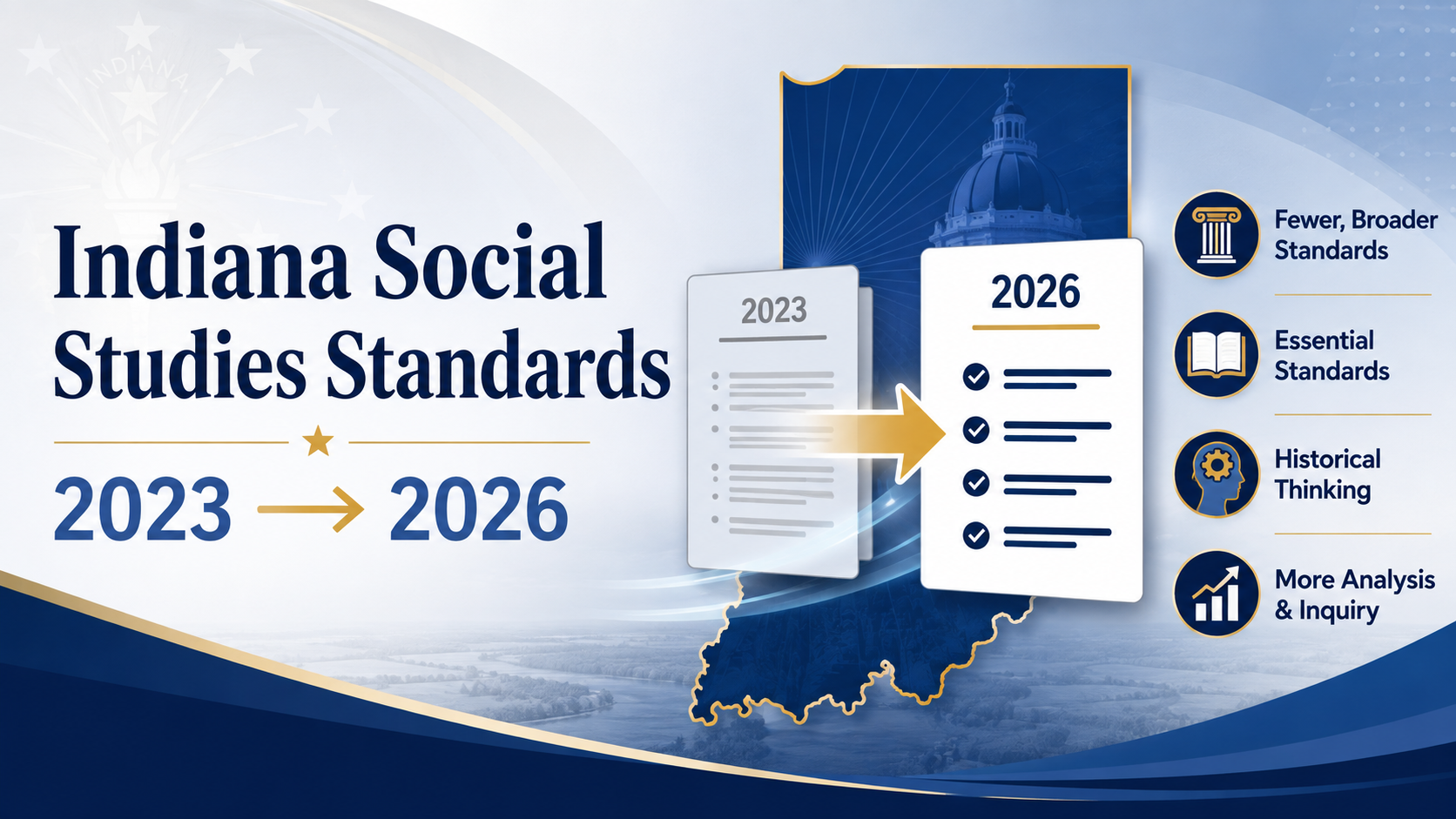
The 2026 Indiana Academic Standards for Social Studies represent a significant update to the 2023 standards, but they do not completely change what Indiana students are expected to learn. Instead, the revisions generally streamline, combine, clarify, and reorganize standards while placing greater emphasis on the skills students use to study history, government, geography, and economics. IDOE continues to organize K–8 social studies around History, Civics and Government, Geography, and Economics, while providing separate standards for high school courses.
The Biggest Changes
Fewer, Broader Standards
Many detailed 2023 standards have been combined into broader 2026 expectations. In some cases, several individual standards now appear under one larger standard. This means that a reduction in the number of standards does not necessarily mean less content must be taught.
New “Essential” Standards
The 2026 standards with an “E” for Essential. These represent knowledge and skills IDOE has identified as particularly important for students to master by the end of the grade or course. All standards are still required, but the Essential designation provides teachers and schools with clearer priorities when making instructional decisions.
Greater Emphasis on Historical Thinking
The new standards place increased attention on students doing more than remembering names, dates, and events. Students are expected to analyze evidence, understand historical context, recognize cause and effect, compare perspectives, and use primary and secondary sources. IDOE specifically identifies historical thinking as an important part of K–12 social studies instruction.
Stronger Connection to the C3 Framework
The 2026 revision incorporates ideas from the National Council for the Social Studies College, Career, and Civic Life (C3) Framework. This increases the emphasis on critical thinking, inquiry, evidence-based reasoning, civic understanding, and literacy within social studies.
More Emphasis on Analysis and Application
Teachers will see more standards using expectations such as analyze, evaluate, compare, explain, assess, and examine. Students will increasingly be expected to explain why events happened, evaluate their significance, and connect historical developments rather than simply identify information.
Content Has Been Consolidated and Reorganized
Some topics that appear to have been removed from the 2023 standards are actually incorporated into broader 2026 standards. Teachers should therefore avoid assuming that a topic no longer needs to be taught simply because its old standard number disappeared.
Additional High School Course Standards
IDOE’s 2026 social studies standards now includes separate standards for Global Economics, Psychology, Sociology, Indiana Studies, and World Geography, in addition to the established courses such as U.S. History, U.S. Government, Economics, Geography and History of the World, and World History and Civilization.
Overall Impact on Teachers
For most teachers, the biggest change will be how the standards are used rather than a complete change in what is taught. Teachers will need to update pacing guides, curriculum maps, assessments, and lesson objectives to match the new numbering and wording. They should also identify the Essential standards and make sure those receive sufficient instructional time.
The broader standards may provide teachers with more flexibility in selecting examples, activities, primary sources, and assessments, but they also place more responsibility on schools and teachers to determine the appropriate depth and sequence of instruction. IDOE specifically states that the standards establish required academic expectations but are not themselves a curriculum, leaving curriculum selection and instructional sequencing to local school corporations.
Bottom Line
The shift from the 2023 to 2026 Indiana Social Studies Standards is primarily a move toward fewer, broader, more skill-focused standards. Content knowledge remains important, but students are increasingly expected to use that knowledge to analyze evidence, explain relationships, evaluate ideas, and think historically. For teachers, this means less attention to simply “covering” individual standards and greater attention to building deeper understanding and social studies thinking skills.